Emmanuel Claude
Shattering a wine glass with your voice: myth or reality?
Yes, it can be done! However, it requires a strong voice and some practice. But how is this even possible?
Every object has a natural frequency at which it can be set into vibration most easily. This is known as the resonance frequency (see infobox). When a glass is tapped, it produces a sound that has exactly this frequency. If, conversely, this tone is played back through a loudspeaker, the wall of the glass begins to vibrate.
Through resonance, the vibrations are amplified. This principle is similar to pushing a child on a swing: when the pushes are applied at exactly the right moment, the amplitude increases dramatically, even though each individual push is small.
If the vibration amplitude becomes high enough, the internal stresses exceed the structural strength of the material, and the glass shatters.
Infobox
Every object can be set into vibration by external excitation. Each object has a natural vibration frequency at which it vibrates particularly strongly. This frequency is called the resonant frequency.
This is similar to a swing: if you push it at the right rhythm, it swings higher and higher. If you push it at the wrong moments, it barely swings at all.
In the case of a glass, the correct pitch (sound frequency) of the voice causes the vibrations to grow larger and larger. If the vibration becomes stronger than the material can withstand, the glass can shatter.
Here are some everyday examples:
-
Strong synchronized marching can set a bridge into vibration (which is why soldiers do not march in step on bridges).
-
Guitar strings or violin bodies amplify certain tones through resonance.
Do the candidates on Take Off need to be good singers to solve the challenge?
No! The candidates were supported by a loudspeaker that could play tones and did not have to sing themselves.
In this challenge, the task was to determine the resonance frequency (natural frequency) of a wine glass - that is, the tone at which the glass vibrates particularly strongly. This can be found by lightly tapping the glass. The candidates then had to generate exactly this frequency using sound in order to make the glass shatter.
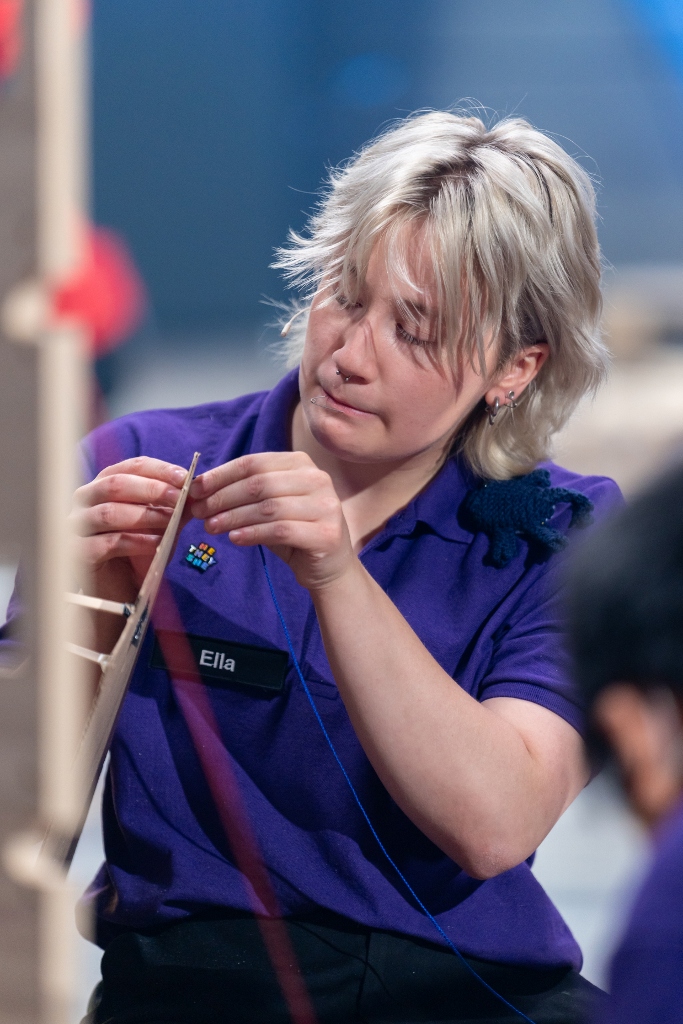
Each candidate was given a wine glass, a loudspeaker, a frequency analyzer (a measuring device that determines pitch), and a straw. The straw placed inside the glass serves to make the vibrations more visible. The more the straw jumps back and forth inside the glass, the closer one is to the correct resonance frequency.
The challenge therefore consists of two steps:
- Resonance identification: First, the glass is lightly tapped. Using the frequency analyzer, the exact frequency at which the glass vibrates most strongly is determined.
- Acoustic resonance: This exact frequency is then played through the loudspeaker. Resonance occurs: the glass is set into vibration by the oscillations of the air and eventually shatters.

Author: Diane Bertel
Editors: Joseph Rodesch (FNR), Lucie Zeches (FNR)
Photos: Emmanuel Claude
Want to try the challenge yourself? Here’s what you need:
- 1 thin-walled wine glass (one that is no longer needed!)
- 1 loudspeaker with a connection to a smartphone
- A frequency analyzer (e.g. smartphone apps such as “bs spectrum” or “Cleartune”)
- An app for playing a specific frequency, e.g. a tone generator
- As an alternative to a frequency analyzer: 1 straw (the straw vibrates when you have found the correct frequency and the glass starts to oscillate)
- Sandpaper (to roughen the glass; this creates a scratch that makes breaking easier)
Step-by-step instructions:
Place the wine glass on a stable surface.
- Lightly tap it to create vibrations.
- Use the frequency analyzer to identify the resonance frequency.
- Position the loudspeaker so that it is directed straight at the glass.
- With the tone generator, play the precisely determined resonance frequency. A straw inside the glass should jump back and forth vigorously.
- If you want the glass to break, lightly scratch the surface and the rim with sandpaper. Then carefully increase the volume until the glass breaks due to the vibrations.
Tip: Even small deviations from the resonance frequency will prevent the glass from shattering. Precision is therefore crucial. It is important to identify the main frequency, as a glass usually vibrates at several frequencies. The main frequency is the frequency with the highest amplitude.

Key factors:
- Hitting the resonance frequency precisely: every glass is different (size, shape, material).
- Sufficient volume: the sound energy must overcome the material’s resistance.
- Frequency stability: a continuous tone without fluctuations.
Infobox
The Broughton Suspension Bridge was a suspension bridge over the River Irwell in England, built in 1826. On April 12, 1831, it collapsed as around 70 soldiers were marching back to their barracks. At first, they were not marching in step. Encouraged by the vibrations of the bridge, some soldiers began whistling a marching tune, whereupon the soldiers apparently synchronized their steps with the tune and the vibrations, significantly amplifying them. One pylon collapsed, and parts of the roadway fell five meters into the river. Around 40 soldiers fell into the water; there were no fatalities, but about 20 were injured.
This event made the problem of resonance amplification widely known. Since then, military regulations have stated: “Troops must not march in step across bridges.” To this day, a sign on London’s Albert Bridge bears the warning: All troops must break step!
If you want to see how the contestants solved this challenge in the show, then look here: (this video will only be published on the 23rd of January.)
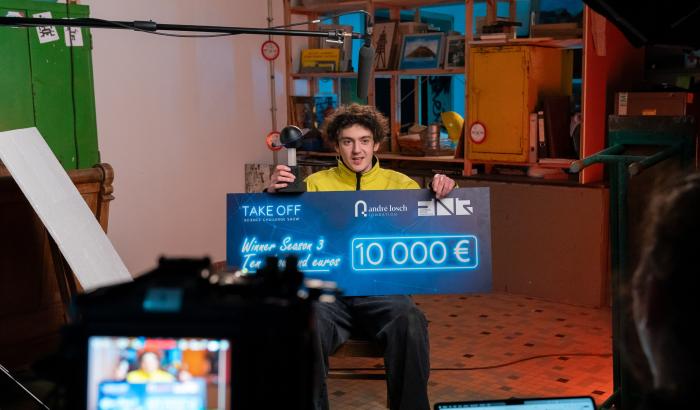
A few impressions from the third studio episode: