What is this challenge about?
The participants are presented with a simple computer code that corresponds to an image. They have to filter out the correct picture from all the given pictures. Which fish does the computer draw with this code? Can you figure it out?


Infobox
You have to count the number of shapes mentioned in the code and compare them with those shown in the pictures. The pictures with the wrong number of shapes can thus be easily excluded.
So in this case there are 3 ellipses (or circles), 3 triangles and a line. Fish no. 1&3 have no line: ruled out. Fish no. 2&5 do not have enough ellipses; and fish no. 4 is missing a triangle: so it can only be fish no. 6!
The numbers represent the coordinates and sizes of the respective shapes. These coordinates can be used to position the shapes on the fish, but this is not necessary here.
Want to know how the contestants from the show solved the Fish Code?
Then take a look at episode 3! (the episode will air on the 19th of January).
What is the scientific background to this challenge?
When people draw pictures or plans, they usually think of drawing lines. When we use computers to create drawings (CAD - Computer Aided Design), drawing takes on new dimensions. Every drawing created by a computer must be represented by coordinates and corresponding shapes.
Computer-aided design (CAD) refers to the computer-aided creation, editing and optimization of images and technical drawings. CAD software is used in a variety of sectors, including architecture (building plans, floor plans, façade designs and landscape planning), engineering (circuit diagrams or technical drawings for manufacturing) and product design (modelling objects in three dimensions to visualize, simulate and test a design). CAD is also used in medical technology: e.g. when designing implants, prostheses and medical devices or when creating precise models for surgical simulations.
Today, computers can even generate images or drawings automatically - i.e. without any code specified by humans - by using neural networks. This is done through training processes in which the computer learns to recognize and reproduce patterns. Neural networks are a branch of artificial intelligence (AI) and machine learning (ML).
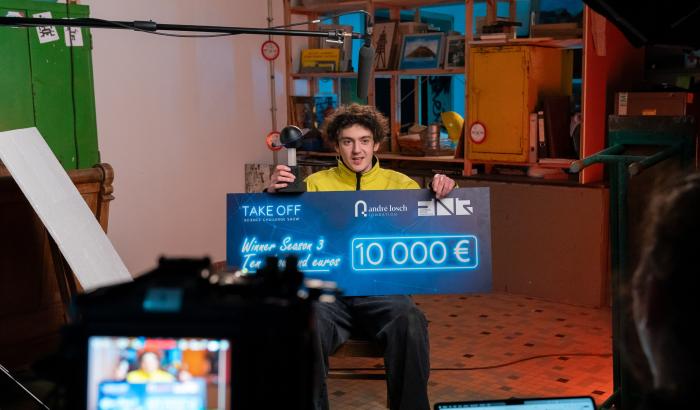
A few impressions from the third episode


Author: Diane Bertel
Editors: Lucie Zeches (FNR), Joseph Rodesch (FNR)
Photos: Emmanuel Claude