Police Scientifique Luxembourg
Science meets practice: As part of the Take Off Science Challenge Show, Randy Topper, Valérie Ries and Gilles Rabinger from the Scientific Police provide fascinating insights into their work. In this interview, they explain how the challenges of the show can be connected with real investigative cases – from document analysis to the evaluation of the smallest traces.
Biographies
Infobox

Valerie has been working at the Scientific Police of Luxembourg since 2016, first in the fingerprint laboratory and, for the past year, as Deputy Head of the Scientific Police as well as in the department for documents and handwriting.
Her daily work has changed significantly as a result. In the past, she mainly worked in the laboratory; today, her role focuses primarily on coordination and organization. She works closely with the officers who collect evidence at crime scenes. At the same time, she coordinates the different specialist areas - such as document analysis, footwear impressions, or ballistics - and oversees the entire examination process.
Valerie’s passion for forensic science began with CSI: Las Vegas on RTL. She was also fascinated by the lectures of Dr. Mark Benecke on forensic entomology. She studied Forensic Science at the University of Kent in Canterbury, England, where she completed both her Bachelor’s and Master’s degrees.

Randy studied Chemistry at the University of Strasbourg, where he completed his Bachelor’s degree. He then studied Forensic Science at the School of Criminal Justice in Lausanne, Switzerland, where he obtained both a Bachelor’s and a Master’s degree. His first job after university was with the police in Fort Myers, Florida, United States. There, he worked as a crime scene investigator, examining evidence at crime scenes. Since 2016, he has been working at the Scientific Police of Luxembourg: first in the fingerprint laboratory and later in the department for documents and handwriting.
And how did he get into this field? It all began on a Tuesday evening at 8:15 p.m., when he first encountered this profession through CSI: Las Vegas on RTL. Two years before graduating from high school, he knew: that is exactly what he wanted to do.
Gilles completed his training as a police officer in 2002. After several years in patrol duty, he worked as a crime scene investigator in Mersch from 2008 onward (mainly dealing with property-related crimes). Since 2018, he has been a member of the Scientific Police of Luxembourg and is responsible for the analysis of tool marks, footwear impressions, tire tracks, glove marks, and other types of technical impression evidence.
What others learned through academic study, he acquired over many years directly at crime scenes and through continuous professional training - learning by doing!
Infobox
The Scientific Police supports the police and the justice system in solving crimes by applying scientific methods. Its goal is to determine what actually happened based on objective evidence.
At crime scenes, it searches for traces such as fingerprints, blood, DNA, or other material evidence. These traces are carefully collected and later examined in specialized laboratories. The results help identify individuals, reconstruct the course of events, or exclude suspects. The Scientific Police does not decide on guilt or innocence; rather, it provides scientific evidence on the basis of which courts make their decisions.
Randy: You work professionally with forged documents. When are you called in?
Randy: Document analysis is commissioned either by the judiciary or by police investigators, particularly in cases where the authenticity of a document or the authorship of handwriting is in doubt. We examine documents using handwriting analysis as well as technical examination methods. For example, we check whether a certificate is authentic or whether a signature was written by hand or printed mechanically.
You also analyze inks from different ballpoint pens or printers. How does that work?
Randy: First, the ink is examined under a microscope. Ballpoint pens, gel pens, or fountain pens show characteristic features. The inks are then examined using light of different wavelengths. For example, infrared light may be absorbed by one ink while another becomes transparent under it. By carefully combining light sources and filters, fine differences between inks can be detected.
With printer inks, it is already possible under the microscope to distinguish between inkjet and laser printing. Manufacturers such as Canon or HP use different raster structures, which allows conclusions to be drawn about the manufacturer.

Here is a picture that was taken while testing the challenge from episode 10 of Take Off. The challenge: contestants were given a diary that had been forged and had to distinguish the original text passages from those that had been added later. Using different light sources, such as UV light or color filters, they observed how various inks reacted to specific wavelengths. This allowed them to determine which passages had been written with a different pen. You can watch the episode further below.
And how does handwriting analysis work?
Randy: Handwriting analysis is crucial for determining the authorship of a piece of writing. Graphic features such as line spacing, margins, letter shapes, pressure, and writing speed are examined. Imitations are particularly noticeable because they go against the natural writing rhythm: the writing often appears more angular, less fluid, and shows unusual connections between strokes or abrupt changes in direction. The next step is to check whether these characteristics match a comparison sample. It is also possible to detect clues about the writing hand - for example, horizontal strokes written from right to left, which may indicate a left-handed writer.
Which skills from your everyday work are particularly highlighted in this episode of Take Off?
Randy: The document challenge reflects my daily work very well, even though the procedures were simplified somewhat for the show. I was able to draw clear parallels with real cases - especially with one case in which I used different wavelengths of light to examine a text. In that instance, it was clearly possible to see that the text had been written with two different ballpoint pens.
What are the most common cases in which you have to examine documents?
Randy: They may involve invoices, financial documents, agreements between two parties, and so on. The key question is often: was the document altered afterward? Sometimes we also receive official documents to determine whether they are genuine originals.
An important point: experts are deliberately given as little information about the case as possible. They receive only a specific question, for example: did this person write the text or not? The human story behind a case can actually hinder our work because it could lead to bias. For that reason, we also have no direct contact with victims or suspects.
Good communication is central in Take Off. Is that also the case in your field of work?
Valérie: In forensic work, the way investigations are presented directly influences how they are understood. Since judges must assess the relationships between the findings themselves, it is essential to communicate the procedures, analyses, and conclusions as clearly as possible. Imprecise or ambiguous communication can unintentionally encourage bias.
Because the different fields of expertise are constantly evolving, it is also important to communicate continuously which methods were used, why they were chosen, and where their limitations lie. Transparency about processes and the limits of what is possible is crucial.
Gilles, you specialize in footwear impressions. Do you find them at every crime scene?
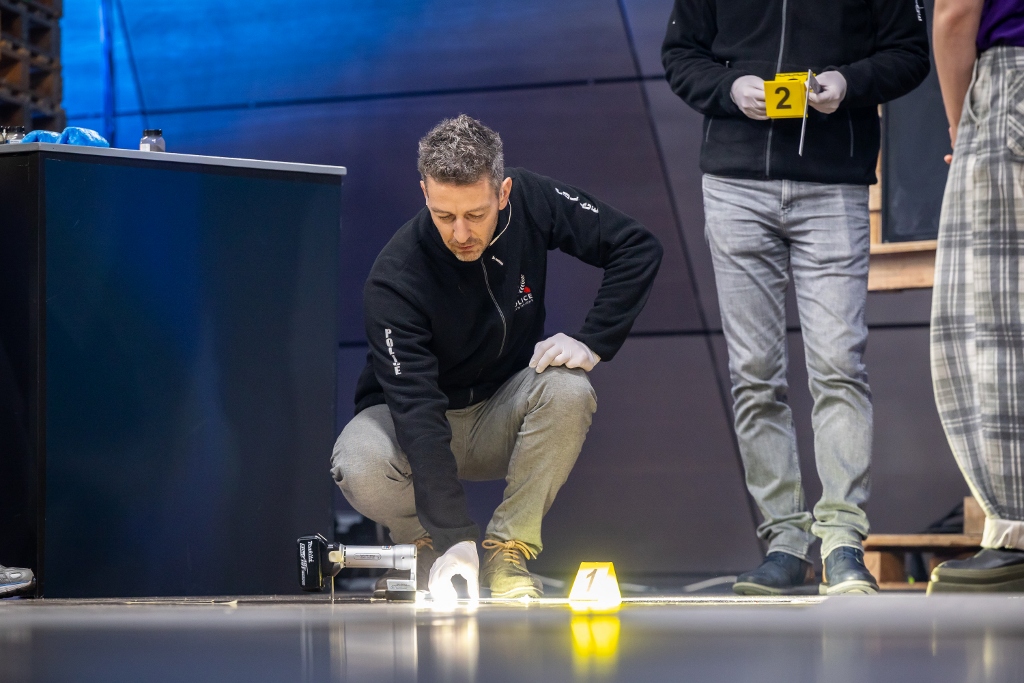
Gilles: Every contact leaves a trace - either by removing dust or by adding it. At a crime scene there is usually far more dust than one might initially expect, and dirt is almost always carried in on the soles of shoes. With the help of special light sources that create oblique lighting, this dust can be made visible.
The particular challenge is to identify the areas where the greatest number of traces are likely to be found - for example, on window sills.

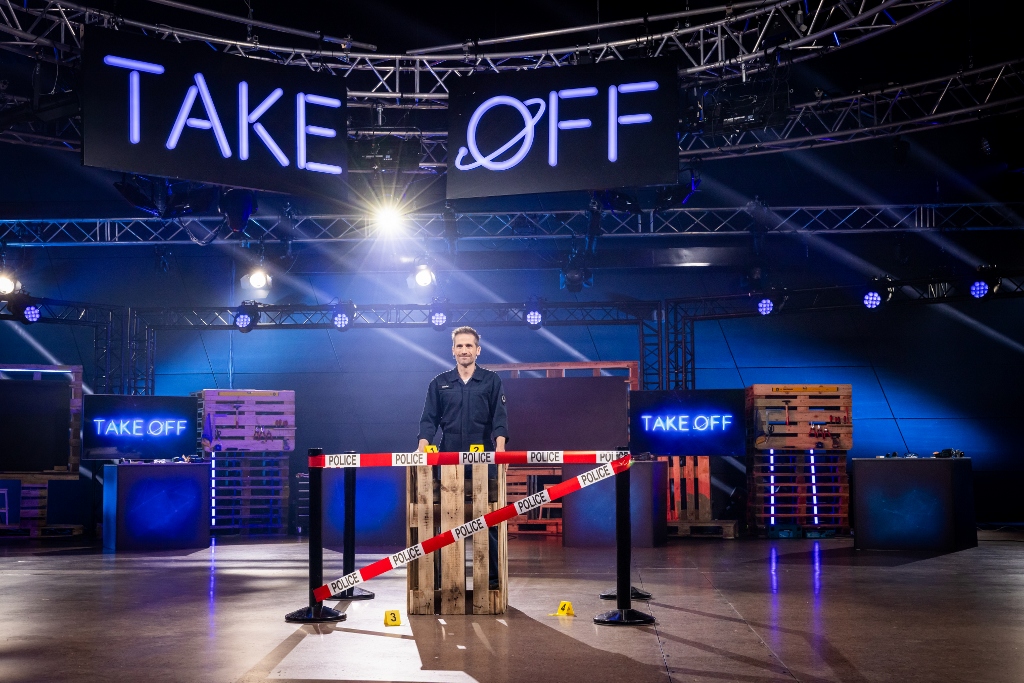
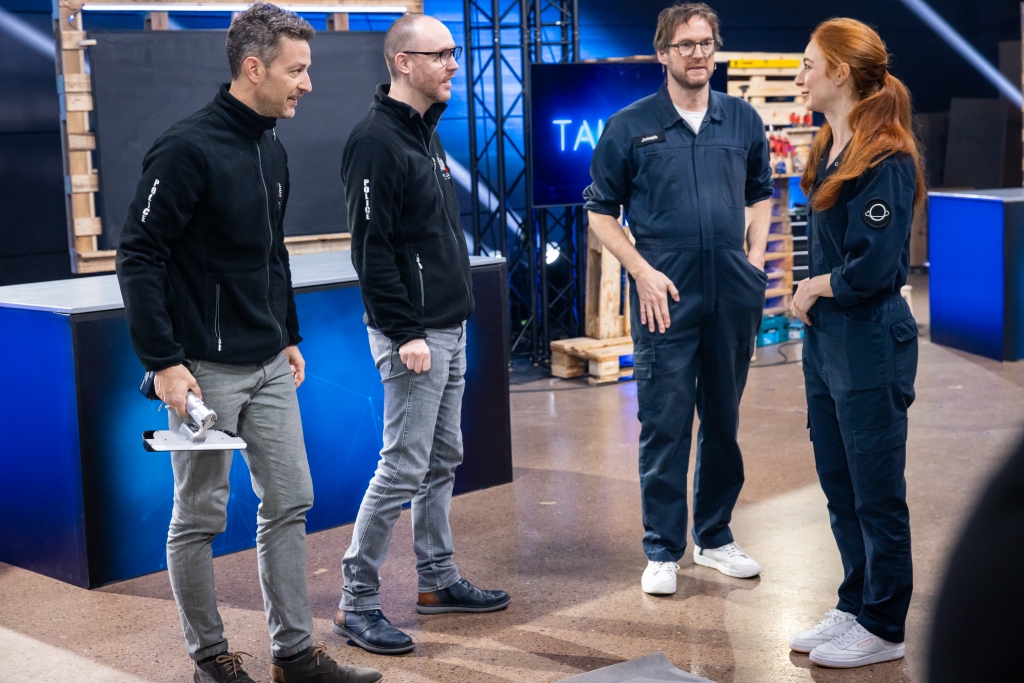
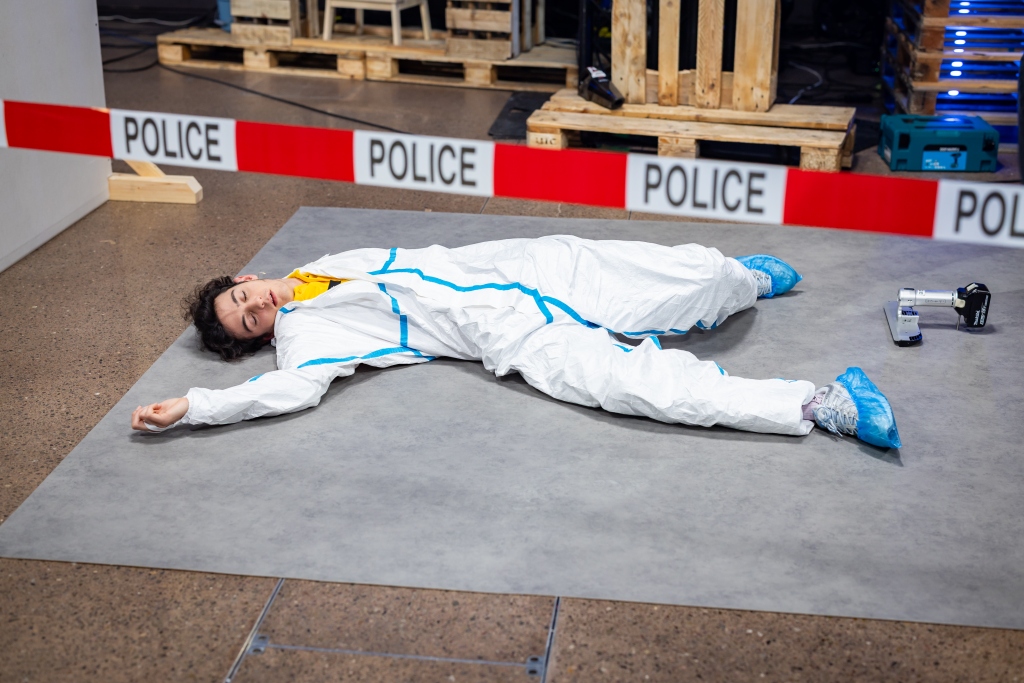
Here is a picture from the corresponding challenge in episode 10 of Take Off. The task was as follows: the teams had to determine, based on footprints on the floor, who had fired at the wall. After identifying the relevant traces, they secured an impression of the footprints using forensic techniques. They then compared these with several pairs of shoes provided in order to determine which pair belonged to the shooter.
What kind of information can a footwear impression reveal about a person?
Gilles: A great deal! Footwear impressions primarily help us identify series of crimes, such as burglaries. The same sole patterns and sizes found at different crime scenes can provide valuable investigative leads.
In addition, movements can be reconstructed. In a room with several people involved, the traces can show who was where and can even provide information about how events unfolded (for example, in connection with the direction of a gunshot in firearm-related offenses).
If the quality of the trace is good enough, we can identify a shoe based on individualizing features (for example, cuts in the sole caused by broken glass). When a person is arrested, shoes are among the first items that are seized. They later serve as comparison material and can be crucial in linking a trace definitively to a person.
In an investigation, which is more informative: a footprint, a fingerprint, or a tool mark?
Valérie: A good investigation only works when everyone collaborates. A fingerprint alone does not necessarily solve a case. All areas of expertise must be brought together, and the context of the traces must be understood to obtain a clear picture.
Gilles: DNA alone is also not enough to reliably solve cases; it is only one piece of the puzzle. DNA can also easily be transferred. For example, a taxi driver in New York may leave skin flakes in his taxi; a passenger who later commits a murder could unintentionally transfer these flakes to the crime scene, even though the taxi driver was never there. This is known as secondary transfer. Only the complete analysis of all traces provides a reliable result.
As Edmond Locard once said: “Every contact leaves a trace,” which became a fundamental principle of forensic science. Incidentally, he opened the world’s first forensic laboratory in Lyon in 1910.
The Take Off contestants were under enormous time pressure during the show - how important is scientific accuracy under time pressure in real investigations?
Gilles: One must clearly distinguish between evidence collection at the crime scene and the later analysis. At the crime scene, time pressure can arise, especially during on-call duty. It may happen that more than 20 burglaries have to be processed within a single week. Even then, careful cataloguing of traces is essential. During the analysis, however, there must be no pressure. People who work under stress tend to overlook or misinterpret important details - and that must not happen. Casework continues steadily, but absolute care is required when examining details.
Leadership also plays an important role here in creating good working conditions.
Valérie: Of course, judicial authorities push for quick results - which is understandable - but a balance must be found. Prioritization is essential.
Is the number of cases increasing in Luxembourg?
Valérie: Yes, clearly - in all areas. But that does not mean the population is becoming more criminal. The population is growing, and with it the absolute number of cases.
What personally motivated you to take part in Take Off?
Randy: Take Off is a very interesting concept that sparked my curiosity. First, the show itself - where science, speed, and logical thinking are all required - and second, the challenge of designing a task based on my own field of expertise. We were immediately willing to participate.
Gilles: Normally, we operate quietly behind the scenes. Take Off therefore offered us a wonderful opportunity to step out of the shadows and into the spotlight to show that forensic science is much more than an exciting TV crime drama.
Valérie: Our goal is to give people a look behind the blue lights and show that police work is far more complex than it may appear at first glance.
What message would you like to give to the viewers of the Take Off show?
Gilles: We would like to encourage young people to pursue a path in forensic science. The police urgently need motivated professionals who are interested in forensic work.
Valérie: Science is alive and constantly evolving. The creativity and curiosity of the young participants in the show impressed us greatly - and that is exactly what we also need in forensic science. Moreover, working in forensics has a direct impact on society: solving crimes and actively contributing to society is very fulfilling.
Randy: Forensic science brings together a wide range of disciplines: biology, chemistry, physics, mathematics, statistics… It is precisely this diversity that makes the field so attractive.
Would you like to see how the contestants on the show solved the challenges set by the Scientific Police? Then watch the episode:
(The episode will only be released on 13 March 2026.)
Interview: Diane Bertel
Editors: Lucie Zeches (FNR), Joseph Rodesch (FNR)
Photographer: Emmanuel Claude